

Every step counts.
Health and sustainability together in carbon reduction. Learn more!

Health and sustainability together in carbon reduction. Learn more!
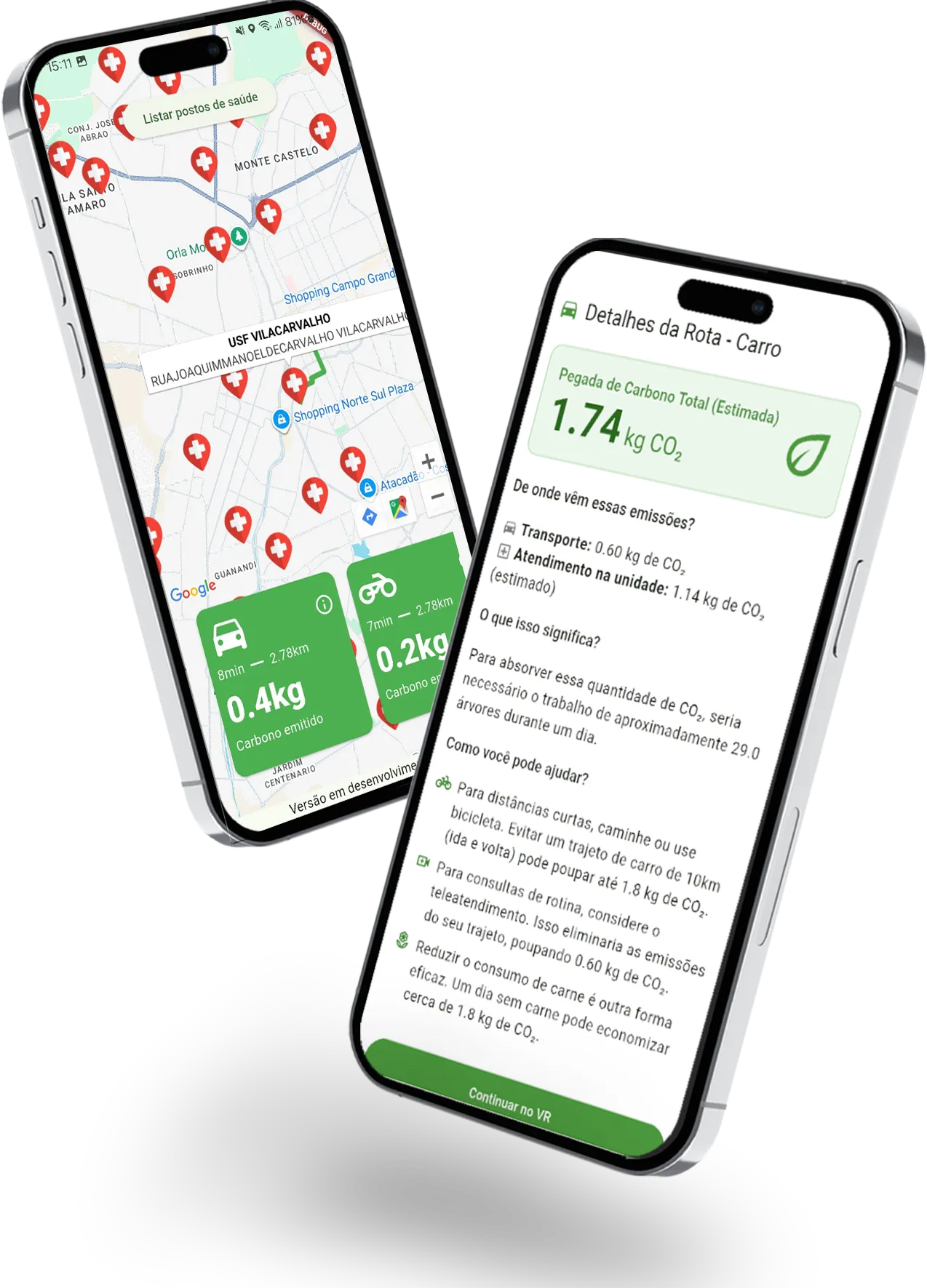
The project PEGADA SESI: From Measurement to Action for a Low-Carbon Health brings together health and sustainability through a carbon emissions counter activated when the user accesses the healthcare system. The initiative encourages care coordination, influenza immunization, and the use of telehealth as strategies to reduce travel and resource consumption, minimizing emissions and advancing in the decarbonization process.
The app performs a screening to identify the user’s risk factor and, according to the severity, directs them to a healthcare facility. The system indicates the nearest healthcare units and presents in advance the amount of carbon that will be emitted according to the type of vehicle.
CO2 Emission(kg) = (km traveled/km per liter of vehicle) X CO2 emitted per liter
High CO2 emission. Increases traffic and emissions, greater environmental impact.
An average CO2 emission. Lower fuel consumption and higher efficiency compared to cars reduce travel time and urban congestion.
A low CO2 emission. Reduces emissions per person, efficient collective use.
A low CO2 emission. Collective use provides a smaller carbon footprint per passenger.
Zero CO2 emission. Active mobility, no emissions while promoting health.
Almost zero CO2 emission. Eliminates travel, reduces emissions and expands access.
Telemedicine and online consultations – avoid unnecessary travel for patients and professionals, reducing transport-related emissions.
Promotion of preventive health – reduces hospitalizations and travel, decreasing resource consumption and the healthcare system’s carbon footprint.
Digitization of administrative processes and exams – reduces paper use, printing, and trips for document delivery.
Rational use of energy in hospitals, clinics, and health units – optimizes equipment operation and climate control, lowering electricity and fossil fuel consumption.
Sustainable management of healthcare waste – promotes proper separation and disposal of recyclable materials, reducing incineration and related emissions.
ENVIRONMENTAL RESOURCES MANAGEMENT. Care Pathways: Guidance on Appraising Sustainability – Condition Self-Management Module. Coalition for Sustainable Pharmaceuticals and Medical Devices (CSPM), out. 2015.
ENVIRONMENTAL RESOURCES MANAGEMENT. Care Pathways: Guidance on Appraising Sustainability – Emergency Department Visit Module. Coalition for Sustainable Pharmaceuticals and Medical Devices (CSPM), out. 2015.
ENVIRONMENTAL RESOURCES MANAGEMENT. Care Pathways: Guidance on Appraising Sustainability – GP Consultation Module. Coalition for Sustainable Pharmaceuticals and Medical Devices (CSPM), out. 2015.
ENVIRONMENTAL RESOURCES MANAGEMENT. Care Pathways: Guidance on Appraising Sustainability – Inpatient Bed Day Module. Coalition for Sustainable Pharmaceuticals and Medical Devices (CSPM), out. 2015.
ENVIRONMENTAL RESOURCES MANAGEMENT. Care Pathways: Guidance on Appraising Sustainability – Main Document. Coalition for Sustainable Pharmaceuticals and Medical Devices (CSPM), out. 2015.
ENVIRONMENTAL RESOURCES MANAGEMENT. Greenhouse Gas Accounting Sector Guidance for Pharmaceutical Products and Medical Devices. GHG Protocol Product Life Cycle Accounting and Reporting Standard, nov. 2012.
ENVIRONMENTAL RESOURCES MANAGEMENT; NOVO NORDISK. Case Study: Type 2 Diabetes Management Care Pathway. Coalition for Sustainable Pharmaceuticals and Medical Devices (CSPM), out. 2015.
NATIONAL HEALTH SERVICE (NHS). Delivering a ‘Net Zero’ National Health Service. London: NHS England, jul. 2022.
SUSTAINABLE MARKETS INITIATIVE HEALTH SYSTEMS TASK FORCE; BOSTON CONSULTING GROUP. Decarbonising Patient Care Pathways: How Choices in Patient Care Can Drive Reductions in Carbon Emissions. Sustainable Markets Initiative, nov. 2022.